
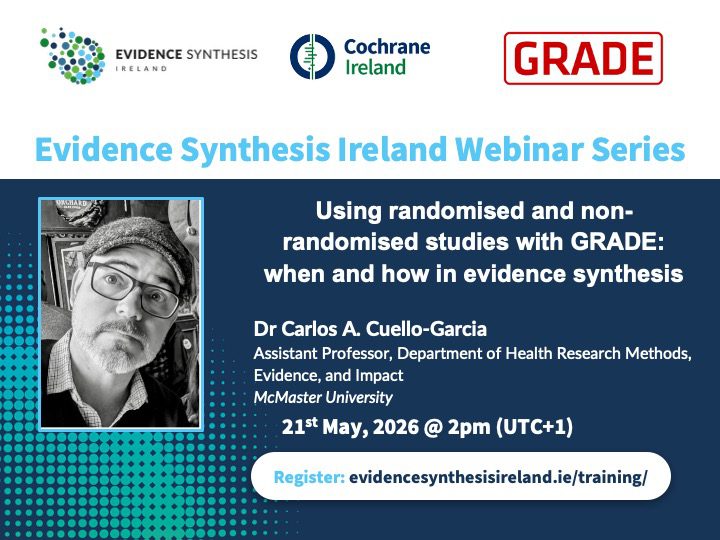
Webinar: Dr Carlos A. Cuello - Using Randomized and Non-randomized Studies with GRADE: When and How in Evidence Syntheses
Event Details
To register, CLICK HERE
This webinar will present GRADE Guidance 44, which provides a structured, practical approach to using randomised controlled trials (RCTs) and non-randomised studies of interventions (NRSIs) in evidence syntheses of health interventions. While RCTs remain the preferred source of evidence, many clinical, public health, and policy questions require consideration of observational evidence. The session will walk participants through the key principles and four-step framework proposed in the guidance, including assessing certainty of evidence, defining decision thresholds, evaluating congruency of effect estimates, and determining when and how evidence from different study designs can be integrated—or should remain separate. Real-world examples will be used to illustrate common challenges and decision points faced by reviewers informing guidelines and HTAs. The webinar is aimed at systematic reviewers, guideline developers, HTA analysts, and methodologists seeking practical, defensible approaches to combining evidence from diverse study designs using GRADE.
Speaker:
Carlos A. Cuello-Garcia, MD, PhD, is an Assistant Professor in the Department of Health Research Methods, Evidence, and Impact at McMaster University and a Clinical Research Officer at Canada’s Drug Agency (CDA-AMC). He is an active member of the GRADE Working Group and has contributed to multiple official GRADE guidance documents, including recent guidance on integrating randomised and non-randomised studies of interventions (guidance 44). Carlos has extensive experience in evidence synthesis, health technology assessment, and clinical guideline development, with a particular focus on certainty of evidence and decision-making frameworks. His work bridges methodological research and applied decision-making in real-world policy and regulatory contexts. He has taught and presented internationally on GRADE methods, risk of bias, and the use of observational evidence alongside randomised trials.
more